

If the different store versions of your online store have their own brand styles (for example, because they operate as separate stores), you can set up unique front pages for them with their own content and appearance.
You can edit the front page of the version directly in the MyCashflow theme editor, or create a new template for the front page using the Web Designer extension. You can also give the task to your online store's designer, or order it from MyCashflow as a project.
Editing the front page in the theme editor
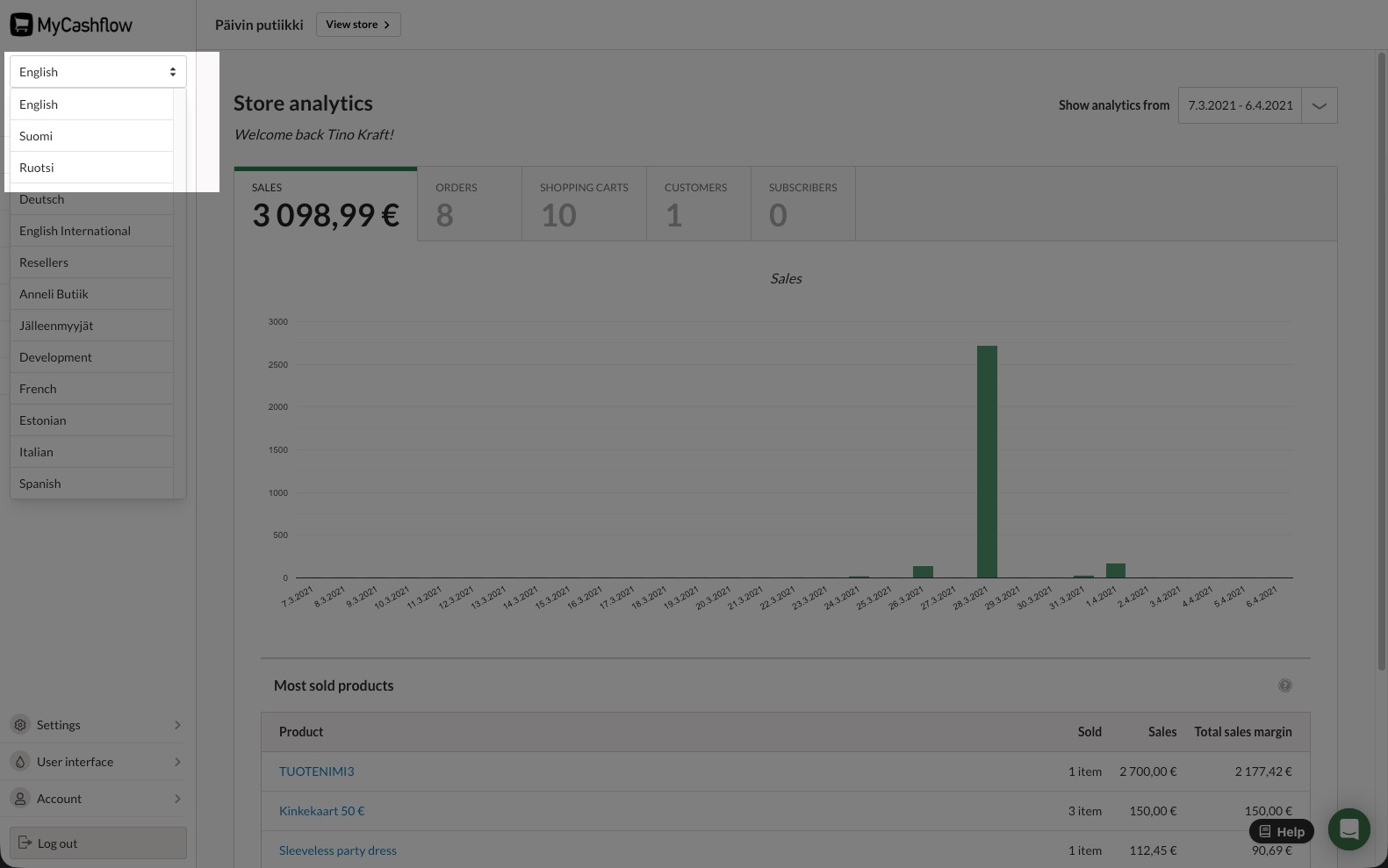
- From the version menu in the top left corner, select the version whose front page you want to edit.
From the Structure tab in the theme editor's sidebar, you can edit the sections of the version's front page. From the Settings tab, you can edit things such as colors, fonts and the navigation model, which affect the version's overall look.
Creating a new template using the Web Designer extension
Creating a template requires the use of HTML and CSS, as well as MyCashflow's Interface markup.
If you're not familiar with modifying your store theme's HTML/CSS/JavaScript files, contact the designer of your online store's theme or our customer service.
The following instructions require that the Web Designer extension is installed in your online store, which gives you access to the template selector and FTP credentials.
- In the version's settings, select as the online store's product catalog the product category you want to act as the version's front page.

- Finally, select for this product category the template you created in step 1.

Due to caching, a new template placed in the theme does not appear in the product category's settings right away. Wait at least 1 minute before selecting the template.
If you haven't enabled the Web Designer extension, you won't be able to select a custom template for the product category.
Now the version uses as its front page the product category you selected, which has its own template. Repeat the steps for all store versions for which you'd like to specify a unique front page.
